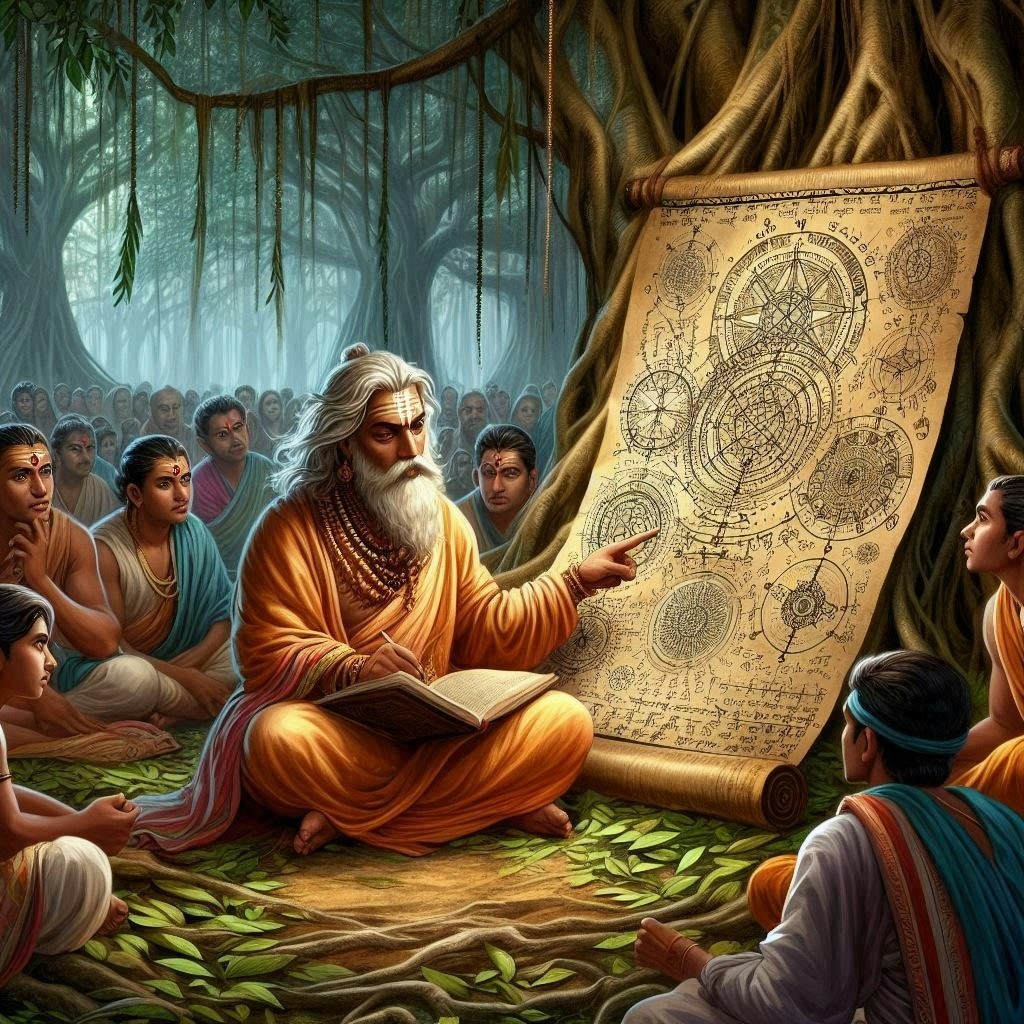
Concept of living in a simulation
The concept of living in a simulation is not directly addressed in the Vedas; however, they discuss the nature of reality and illusion (Maya). Maya is the concept that what we perceive as real is an illusion, which can be related to the idea of living in a simulation.
Computational Limits
The Vedas emphasize the importance of meditation and spiritual knowledge for transcending illusion. In this context, one could argue that limitations in human perception are like computational limits in creating a simulation, suggesting that spiritual understanding can go beyond those limits.
Philosophical skepticism
Vedic philosophy deals with knowledge and reality, asking what is true and what is transient. This skepticism can be seen as a parallel to doubts about the nature of a simulated reality, questioning the validity of our experiences in the world.
Digital physics
The idea that the universe can be viewed as a computational system may reflect Vedic teachings about the interconnectedness of all things (Brahman). It can be interpreted that the laws of physics and existence are part of an underlying order that connects everything, similar to the concept of information and processing in the context of simulation.
Ethical implications
The Vedas address ethics and morality in terms of Dharma, the right duty. Considering we live in a simulation could raise questions about duty and intention, as well as the connections between conscious beings. Vedic ethical principles could provide a framework for understanding relationships and responsibilities, even in a simulated sense.
Observer Effect
In the Vedas, the relationship between consciousness and reality is fundamental. The idea that perception can change the nature of reality is reflected in concepts such as maya (illusion) and the importance of meditation and introspection to understand ultimate truth. Just as in quantum mechanics, where observation influences the state of particles, in the Vedas it is suggested that the state of consciousness can define spiritual experience.
Consciousness and Reality
The Vedas assert that consciousness (or atman) is the fundamental principle of existence. The idea that reality cannot be separated from consciousness aligns with Vedantic concepts that posit consciousness as the basis of all creation. This complements the notion that the universe is maya, an illusory aspect perceived differently according to an individual’s level of consciousness.
Participatory Universe
While not explicitly mentioned in the Vedas, the notion that observers are fundamental to the creation of reality can be seen in the idea that the world manifests through the interaction of individual consciousness with universal consciousness (Brahman). This concept suggests that conscious participation is essential for the realization of the universe.
Anthropic Principle
Although the anthropic principle is not found in the Vedas, the idea that the universe is structured to allow conscious life can be linked to the Vedantic view that creation has an intrinsic purpose allowing for the spiritual evolution of beings. The existence of cosmic laws that favor life reflects a divine harmony sought in Vedic teachings.
Cognitive Frameworks
In the Vedas, the perception of reality is influenced by ignorance (avidya) and knowledge (jnana). The understanding of reality is dynamic and shaped by individual experiences and knowledge. Vedic texts emphasize the importance of self-reflection and meditation to overcome cognitive limitations and reach the truth.
Superposition
In the Vedic context, particularly in the philosophy of Advaita Vedanta, the concept of creation and the nature of reality can be seen as analogous to superposition. Just as particles exist in multiple states until observed, the Vedas describe a unified consciousness (Brahman) that underlies all existence. This suggests that everything is potentially interconnected and exists in various states of reality until one attains self-realization.
Quantum Entanglement
The idea of Quantum Entanglement resonates with the Vedic concept of interconnectedness in the universe. The Vedas emphasize the oneness of all beings and the idea that individual souls (Atman) are part of a greater whole (Brahman). This can be likened to the entangled nature of particles, where the state of one affects another, regardless of distance, illustrating a profound connection within the cosmos.
Uncertainty Principle
The Uncertainty Principle parallels the Vedic understanding of knowledge and perception. The Vedas assert that ultimate reality (Brahman) cannot be fully comprehended or described through language or intellect alone. Just as the more we try to measure a quantum system, the more uncertain we become about other aspects, the Vedas suggest that our grasp of the ultimate truth is inherently limited by our dualistic perception of the world.
Wave-Particle Duality
Wave-Particle Duality can be compared to the Vedic idea of duality in creation; both manifest as material (Maya) and spiritual (Brahman). The Vedic texts describe the physical world as a transient illusion while acknowledging the underlying reality, similar to how quantum entities can exhibit both wave-like and particle-like properties depending on observation.
Quantum Decoherence
Quantum Decoherence corresponds with the Vedic perspective on the cycle of birth and rebirth (Samsara). It illustrates the transition from quantum behavior—representative of pure, unmanifest existence—to classical states shaped by material conditions and individual experiences. This can be seen as a metaphor for how spiritual realization enables one to transcend the illusions of the material world.
Conclusion
Both the teachings of the Vedas and the concepts of quantum mechanics present a profound and complex view of the interaction between consciousness and reality. Both bodies of knowledge suggest that the understanding of our existence is intrinsically linked to the nature of consciousness.
Consciousness plays an active role in constructing reality, and this connection between subjectivity and objectivity invites deep reflection on the human place in the cosmos. In both perspectives, the importance of introspection and spiritual understanding is highlighted to access a deeper and more authentic reality.
The intersection of quantum mechanics and Vedic philosophy reveals a rich tapestry of insights about existence. Both bodies of knowledge emphasize the fundamental role of consciousness in shaping reality—whether through the observer effect in quantum physics or the concept of Brahman in the Vedas.
The parallels such as superposition, interconnectedness, and the limitations of perception highlight a shared understanding of the universe as a complex, interconnected web. This synthesis encourages us to explore not only the scientific aspects of reality but also the spiritual dimensions, suggesting that the quest for knowledge is a holistic journey that unites both science and spirituality in the pursuit of truth.