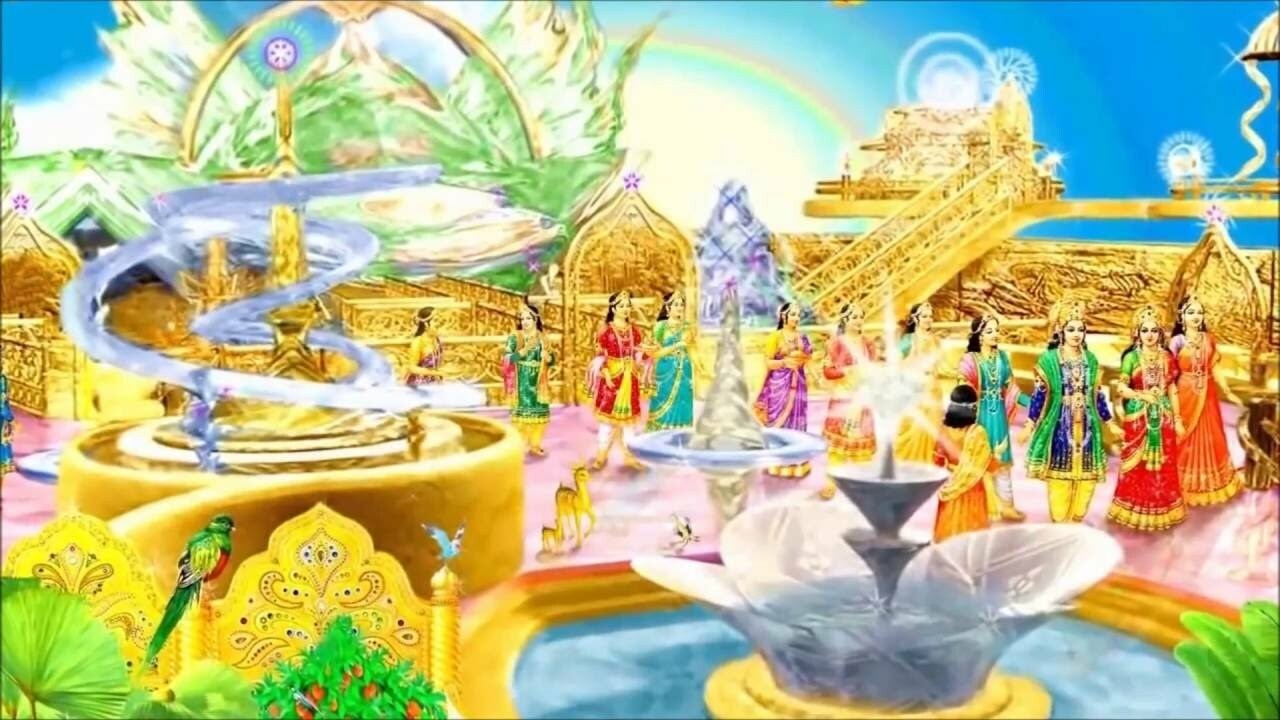
In the Satya yuga the climate remains delightful, never being too hot nor too cold. The voice, pronunciation, and minds of all men became clear and cheerful.
All men became long-lived, without disease, and nowhere was unrighteousness seen. They were virtuous ascetics who honoured and practised truth. Dharma stood steady on four legs.
They have no loss of happiness or affection and devoted to compassion, they never have any dispute, hatred or physical exhaustion. Those subjects had no regular abodes and resorts, as they lived on the mountains, by rivers, lakes or by the sea, where they say that the earth provided honey nectar as their food.
Whatever they desired was achieved everywhere and for ever. By their meditations, everything grew up from the nether worlds through the earth. Those kalpavṛkṣa trees caused strength and fineness of complexion unto them. It destroyed their sickness and old age. Those subjects had everlasting youth, their bodies not requiring purificatory rites.
In their case, even without copulation progeny were born through mere mental conception. Their birth and features were the same in regard to everyone. They were all equal, equipoised, pleased and happy.
Absorbed in meditation of the Supreme Narayana and the Omkara, the Veda was known by them. The subjects of Satya-yuga wandered about as they pleased, there was no manual labour, there was no buying and selling, all the necessaries of life were obtained simply by thought (siddhi).
Kalpavṛkṣa trees designated as their abodes appeared in front of them. They yielded clothes, fruits and ornaments. Similarly, honey of great potency of metaphysical significance was produced in every leafy cup. This honey had great fragrance, good colour and sweet taste. The subjects always sustained themselves thereby and passed their days comfortably at all times.
There were neither animals, birds nor reptiles, nor biting insects at this time. The time was entirely and exclusively pleasant. During the transition to Tretā-yuga, flowers, fruits along with bulbous roots then provided them sustenance as the kalpavṛkṣa’s began to disappear. The earth yielded crops without being tilled, and herbs and plants grew in luxuriance. Barks, leaves, fruits, and roots, become vigorous and abundant.
Sources:
1] Brahmanda Ch.7, 29, 31, 32, 39 2] Bhagavatam Ch. 12.1-3 3] Mahabharata Book 3, Section 143, 187, 190, Book 12 Section 68. 4] Skanda Ch.1.2.40 “The Arrangement of Four Yugas” 5] Linga Uttarabhāga Chapter 39